

.png?width=250&height=206&name=Meggsius%20Control%20icon%20-%20Vencomatic%20Group%20(def).png)
.png?width=250&height=206&name=Meggsius%20Count%20icon%20-%20Vencomatic%20Group%20(def).png)
.png?width=250&height=206&name=Meggsius%20Detect%20icon%20-%20Vencomatic%20Group%20(def).png)
.png?width=250&height=206&name=Meggsius%20Select%20icon%20-%20Vencomatic%20Group%20(def).png)

.png?width=250&height=206&name=Meggsius%20Connect%20icon%20-%20Vencomatic%20Group%20(def).png)
.png?width=160&height=132&name=Egg%20packers%20-%20Vencomatic%20Group%20(2).png)
.png?width=160&height=132&name=Meggsius%20Select%20-%20Vencomatic%20Group%20(2).png)

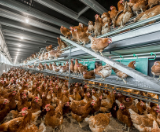



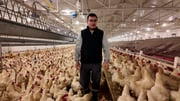
Brazil - Granja Killer’s story is, above all, a story of evolution. Founded in 1966 in Cordeirópolis-SP, the Brazilian company has spanned generations while maintaining its essence in egg production.
It was this mindset that led Adriano Killer, the third generation of the family, to propose a profound transformation in the farm’s production model.
The idea, however, was not immediately adopted. As in many family businesses, the change raised questions and some initial resistance. Even so, the willingness to explore new possibilities prevailed and opened the door to a strategic decision that would change the direction of the business.
After an international experience, Adriano returned to Brazil with a clear vision: the future of egg production lay in cage-free systems.
“When I lived abroad, I often saw cage-free and free-range labels in the markets… so I came back with the idea of transforming our production”
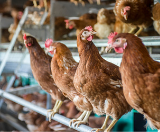
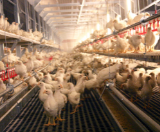
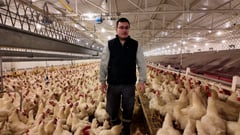
At the time, the farm operated with 90,000 birds in a conventional system. Today, it has 42,000 birds in a 100% cage-free model: a change that required not only investment, but also family alignment, trust, and strategic partnership

A transition built on knowledge and trust
Adopting a new production system brings important technical challenges, especially in markets where know-how is still developing.
It was in this context that Vencomatic Group stepped in as a partner, offering not only technology but applied knowledge.
As Adriano highlights:
“Most of my suppliers did not have knowledge of this type of system, and that’s where Vencomatic Group gave me great support.”
With international expertise and continuous support, Vencomatic supported Granja Killer from the very beginning of the transition, sharing management practices, technical solutions, and close follow-up.

Technology that delivers results
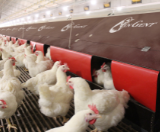
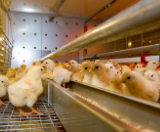
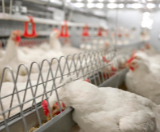
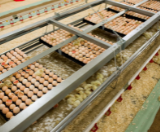
Today, the farm has four houses, three of which are equipped with Vencomatic nests, allowing for a clear comparison between systems.
Based on this experience, Adriano states:
“The results we achieve with the Vencomatic nests here are results I do not get with the competing nest. The percentage of floor eggs does not reach 0.5%.”
This superiority goes beyond equipment design, directly impacting bird behavior, production efficiency, and operational control.

Automation that transforms operations
Another pillar of this evolution was the automation of egg logistics.
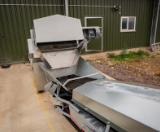
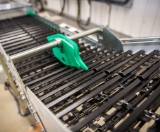
With 125 meters, the Vencobelt runs throughout the entire farm (passing through uphill and downhill terrain), transporting eggs directly from the point of lay to the packing station, with speed adjusted to the pace of the egg room.
The system ensures continuous, safe, and standardized transport, increasing operational efficiency.
The impact is also evident in workforce management:
“Today I cannot imagine the farm here without the Vencobelt… I used to have 17 employees, today we have 7.”
The reduction in labor, combined with efficiency gains, reinforces the role of automation as a key differentiator in cage-free systems.

Looking to the future
With the vision that began years ago now consolidated, Adriano is already planning the next steps.
Expanding production and adopting multi-tier systems are part of a continuous growth strategy - always aligned with animal welfare and operational efficiency.
In this process, Vencomatic Group goes beyond the role of supplier, acting as a long-term partner, contributing technology, knowledge, and continuous support to the development of the business.
Granja Killer’s story shows that tradition and innovation are not opposites, they complement each other. And when combined with partnership, technology, and knowledge, they create solid foundations for the future of egg production.





-1.jpeg?width=240&name=WhatsApp%20Image%202026-09-16%20at%2009.04.59%20(2)-1.jpeg)